
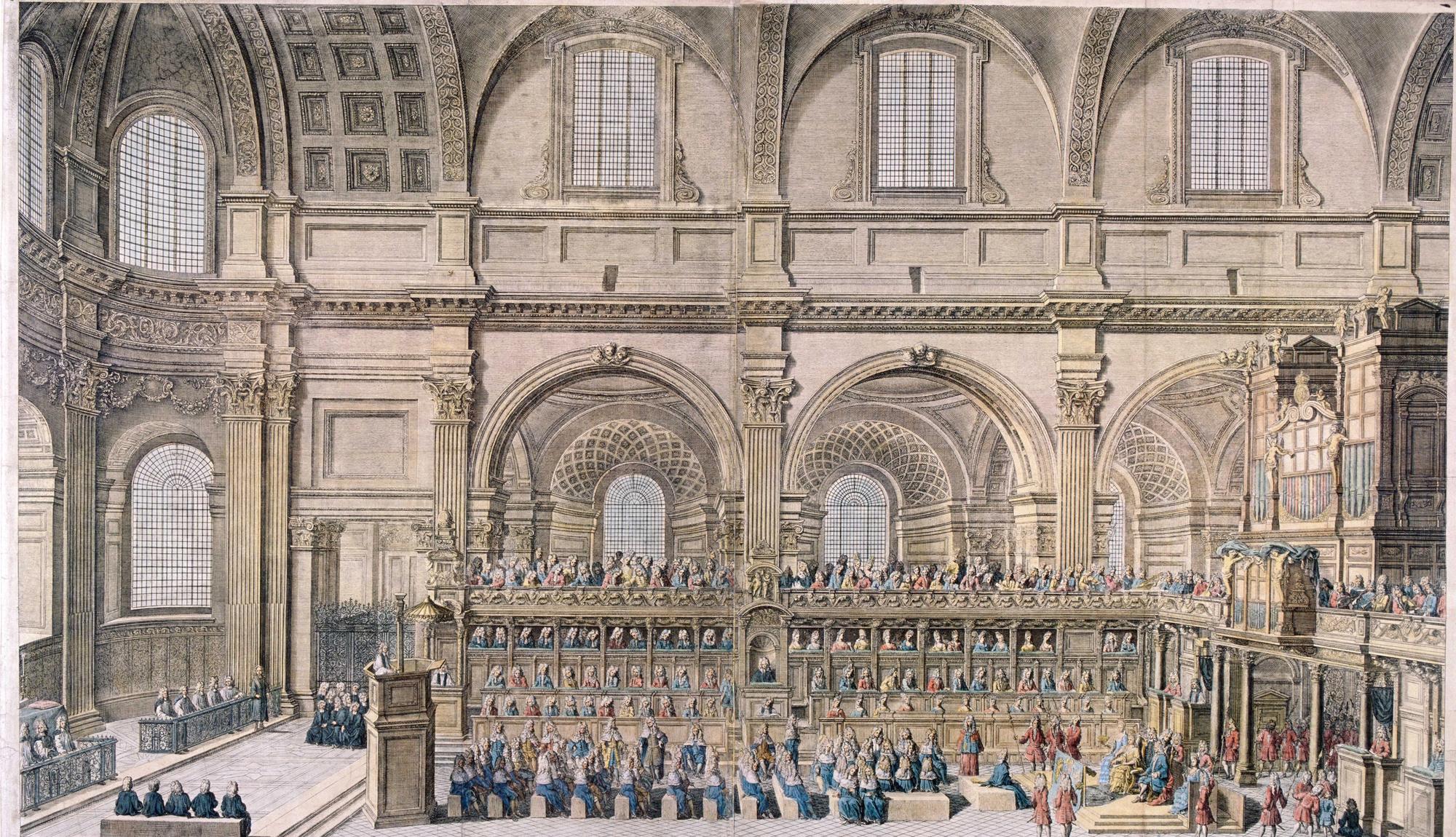
“Better suiting a tavern or playhouse than a church”
Andrew Gant
Alamy Heritage Images / The London Archives (City of London)
Sacred music has always moved on a slightly different timescale from other artistic and cultural movements, largely because it is, for obvious reasons, so closely bound to the urgent religious and political preoccupations of the day. This, in turn, is what makes it so fascinating, because it reflects those preoccupations back to us, both at the top end of society in cathedral and court, but also in the hymns and psalms of the ordinary worshipper in the pew and at home.
The first part of the seventeenth century saw little of the emerging continental Baroque permeating the English tradition, except the possibility that the Catholic Queen Henrietta Maria imported some elements into her own private chapel along with her foreign church musicians.
For church music, the Baroque really began in England with the restoration of Charles II in 1660. A starry generation of composers and performers stood ready to exploit its new possibilities, many of them members of established musical families, including the Gibbons, Lawes and Purcell clans. Captain Henry Cooke refounded the Chapel Royal choir around this talented group, soon adding talented youngsters like Pelham Humfrey and John Blow to his front row of the choir stalls. Matthew Locke, a Catholic, contributed literally from across the road in the queen’s private chapel. This powerhouse of talent and ambition combined with the new king’s love of display and fun and with the influences which he and his acolytes brought back from exile in France to ignite the explosion of creativity which led quickly to the mighty glories of the Purcellian ode and verse anthem, fizzing with energy and sheer delight in setting the words of the King James Bible and the Book of Common Prayer.
The later Stuart monarchs, William, Mary and Anne, had less interest in expensive musical flamboyance than their immediate forebears: and, together with the slightly more downbeat tone of William’s north European Protestantism, it shows in the attractive but rather workmanlike church music of the transitional generation which followed the death of Henry Purcell: Jeremiah Clarke and William Croft.
In 1712 the fires were lit under English baroque sacred music once again with the arrival of a hugely dominant musical personality from Germany, via Italy: a man with more than one foot in the theatre; George Frederic Handel.
Handel’s sacred music doesn’t form a large part of his output, but it covers a wide range, from the grandeur of the four Coronation Anthems of 1727 to the intimacy of smaller-scale works for private events in the Chapel Royal. As always with this magpie-like musical mind, there is much borrowing and re-using of musical material between works, to thrilling effect.
Home-grown composers slightly lost out under Handel’s substantial shadow, but the music of William Boyce and Maurice Greene adds a distinctive English accent to the repertoire. They also served church music well as editors and compilers of a substantial collection of earlier music.
As always with the history of church music, high-end art music is only ever half the story, at best. Out in the countryside the needs of provincial choirs in market towns met new trends such as non-conformism to produce a repertoire of enormous vitality, if not always of great musical sophistication, including distinctive new things like the fuging tune, and, above all, hymns.
About the author
Andrew Gant
Andrew Gant was a choral scholar under the direction of Dr George Guest at St John’s College, Cambridge, where he studied Music and English. He sang professionally with many of the country’s leading ensembles, and was a Lay Vicar at Westminster Abbey for two years in the late 1980s. He subsequently held posts as choir director in the chapels of colleges of the universities of both Oxford and Cambridge, and at the Royal Military Chapel, Wellington Barracks (The Guards’ Chapel). From 2000–2013 he served as Organist, Choirmaster and Composer at Her Majesty’s Chapels Royal, leading and joint-leading the music at many significant royal and national occasions, including the annual Remembrance Day parade at the Cenotaph in Whitehall, the Royal Maundy, the Golden and Diamond Jubilee services for Queen Elizabeth II, the funeral of Her Majesty Queen Elizabeth the Queen Mother and the wedding of Prince William and Catherine Middleton. Andrew is the author of a number of well-received books on musical subjects, including O Sing Unto the Lord: A History of English Church Music (2015), Christmas Carols (two volumes, 2014 and 2015), and Five Straight Lines: A History of Western Music (2021). His compositions include operas, songs and works for choir. He is a Lecturer in Music at St Peter’s College, University of Oxford, and in his spare time is active in local politics with a particular interest in transport issues.