
The English Baroque as a Cultural Phenomenon
Andrew R. Walkling
AKG / Museo degli Argenti, Florence
While the musical Baroque is considered to be a time period stretching from 1600 to 1750, in other artistic practices of the time such as literature, drama, painting, sculpture, architecture, and design, the term describes a particular approach to style that coexisted and blended with other contemporary creative practices. The Baroque form is often characterised as emphasising intricacy, variety, abstraction, hyperbole, and an exploration of the relationship between illusion and reality. Even the origins of the term itself are uncertain, possibly deriving from a type of irregularly shaped pearl or from an ancient mnemonic word used in describing syllogistic arguments.
In the realm of seventeenth-century painting, the Baroque style sacrificed Renaissance principles of symmetry in favour of imbalance and exaggeration, with the depicted image designed to elicit an aura of physical energy and dynamic motion while conveying allegorical messages: an example is Sir Godfrey Kneller’s “William III on Horseback”, in which a variety of mythological figures, some flying on clouds, celebrate the English monarch’s military and naval victories that led to the 1697 Peace of Ryswick with France.
Baroque architecture existed for a very short time in England, and was developed by figures such as Sir John Vanbrugh’s Blenheim Palace in Oxfordshire, where monumental elements are brought together in what has been called ‘a sweeping unity of design’ that exudes spatial rhythm and dramatic flair by means of an undulating sense of movement within the supposedly static stone edifice.
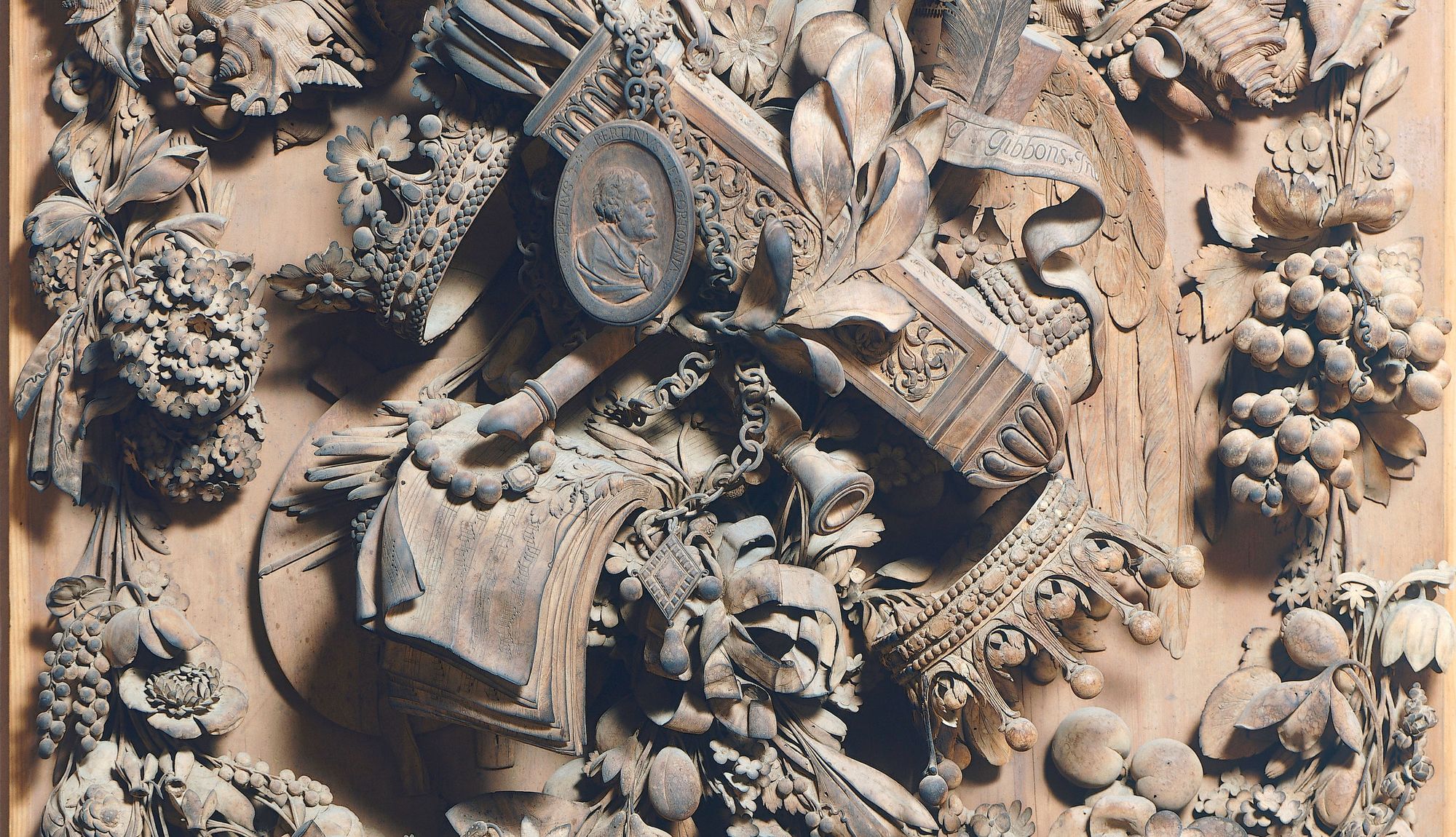
Baroque features are also prominent in the sculptural, or ‘plastic’, arts, including the stunning creations of the English woodcarver Grinling Gibbons, whose ‘Cosimo Panel’ assembles a realistic group of representations of natural and human-made objects, including leaves, flowers, seashells, a lace cravat, musical instruments, and a dog-eared printed book to convey a message of friendship and conviviality from Charles II to the Grand Duke of Tuscany.
Another kind of Baroque art can be found in engravings produced for book illustrations, such as Francis Barlow’s dynamic image accompanying the story of ‘the boy who cried wolf’ in a contemporary published collection of Aesopian fables; Barlow was a consummate draughtsman who specialised in the accurate rendition of animals, and his illustration emphasises the naturalistic brutality of the cautionary tale.
A Baroque style can also be found in literary texts, such as the elaborate poetic form known as the ‘Pindaric ode’, which frequently appeared in courtly contexts as a means of praising the monarch through extravagant and sometimes convoluted language deploying cosmic imagery; often set to music, Pindaric odes were also used to celebrate semi-divine figures like the Christian martyr and musical icon Saint Cecilia. Many Pindaric ode texts remain anonymous, but some were created by leading literary figures such as John Dryden, as well as lesser individuals like Thomas Flatman.
Even though there is no ‘Baroque era’ in the non-musical arts in England, the Baroque style was a key feature of many important and influential works created during the late seventeenth and early eighteenth centuries, and had a lasting impact on British culture.
About the author
Andrew R. Walkling
Andrew R. Walkling is Professor of Art History, English, and Theatre at Binghamton University, State University of New York, U.S.A. He is a specialist on the history of the English Restoration court and of seventeenth-century English court cultural production, including music, art and architecture, literature, and drama. He is the author of Masque and Opera in England, 1656–1688 (Routledge, 2017) and English Dramatick Opera, 1661–1706 (Routledge, 2019), as well as numerous articles on the work of Henry Purcell and his contemporaries.